


USST announced the selected entries for its “Telling My Teaching Story” activity. Following institutional selection and submission, qualification review, and university-level evaluation, 14 articles were ultimately selected. Among them was SBC’s entry on Jeffrey Wang, Head of School of Business and Management at SBC, describing how he leverages the College’s international platform to promote cross-cultural exchange, feeds academic expertise and industry experience back into teaching, and stays true to his educational mission through career transitions.
Below is the English version of his story.
Across Disciplines and Borders: One Teacher’s Commitment and Its Resonance
Jeffrey Wang, Head of the School of Business and Management at SBC
As Robert Frost famously wrote in “The Road Not Taken”: “Two roads diverged in a wood, and I — I took the one less travelled by, and that has made all the difference.” When faced with a fork in the road, I took the road less travelled — moving with the times, pushing beyond my own limits amid constant change, and setting off on a journey altogether different. My experience may well reflect and epitomize the characteristics of this diverse and ever-changing era.
About the Teacher
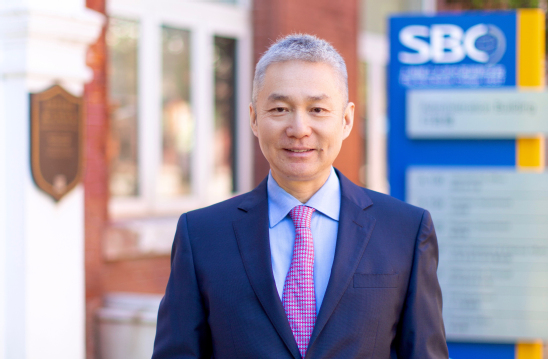
Jeffrey Wang is Head of the School of Business and Management at SBC. He holds a bachelor’s degree in mathematics from Peking University and a PhD in mathematics from the University of Rochester in the United States, and has studied and worked in China, the United States, and France. He previously worked at IBM, where he served successively as a systems architect and operations director, and later founded his own business. While deepening his industry expertise over many years, he also long held adjunct teaching positions at universities.
He joined SBC in 2023, returning to full-time undergraduate education. He brings business theories to life with real business cases and champions a T-shaped knowledge system — broad knowledge across disciplines paired with deep expertise in one field. He teaches students to think critically and use AI tools judiciously, tailors his classes to their needs, and patiently answers their questions, helping them grow and go on to further study. Drawing on the College’s international platform, he promotes cross-cultural exchange and enriches his teaching with solid academic grounding and rich industry experience. Through multiple career transitions, he has remained true to his core commitment to nurturing students and to developing talent through Sino-foreign cooperative education.
Teaching Stories
Years in Business: Bringing Industry Experience Back to the Classroom
Having studied and worked in China, the United States, and France — from a mathematics bachelor's at Peking University and a PhD at the University of Rochester to a programmer, systems architect, operations director, and entrepreneur at IBM — I spent most of my career in the corporate world, yet education was always something I never gave up. I once taught in a university mathematics department, winning teaching awards every year. As I moved from technical into managerial roles, I enrolled in an Executive MBA (EMBA) programme, and before I had even graduated I was invited to teach — a role I went on to hold as an adjunct for many years. When I moved to Shanghai in 2023, I meant to ease into the new environment through adjunct teaching, so I joined the Sino-British College, USST. As I got to know the College, I came to truly love its international teaching atmosphere — and its students and colleagues even more. I therefore decided, after decades in industry, to return to full-time undergraduate education, hoping to bring the experience I have gained across industries, levels, and countries into the classroom and to inspire students in everyday teaching and conversation.
Connecting Knowledge: Teaching for Understanding
Business theories are distilled from real business activity and are inherently abstract, multifaceted, and dynamic. I like to draw analogies between everyday cases and abstract concepts, so students understand not only what something is but why it is so. I care more about understanding than mere knowing. Secondary education stops at what it is and when to use it; university demands how to do it and why. Starting from a grasp of concepts and ideas pays off in the long run, steadily sharpening analytical ability and critical thinking. In class, I try to spark curiosity. When students stop passively receiving and start asking questions of their own, learning truly happens. I show students where knowledge comes from and how it develops, so they see that what they learn is not isolated, rigid doctrine but living ideas that can be connected and integrated. I often tell my students they can treat AI as a study aid — to analyse data, simulate business scenarios, and organize knowledge. But no matter how smart the tool, it can't replace your ability to ask questions and make judgments. Guiding students to develop this mindset is my way of helping them face technological change with greater composure.
One student's growth left a deep impression on me. She was studying business but was always eager to cross disciplinary boundaries. I told her that today's world is full of variables and uncertainty, so building a T-shaped knowledge system would be more prudent: the horizontal bar represents breadth of knowledge, and the vertical bar deep professional expertise. She took it to heart and worked tirelessly toward it, and is about to pursue a master's degree in Marketing Science at University College London. Seeing young people find their way in cross-disciplinary work is the most solid reward a teacher can have.
Teaching to Each Student's Needs: Growing Together Through Mutual Learning
Students learn at different levels, so I explain things simply and watch each student's reactions to adjust the pace. During my own university years, I heard of an old professor who used counting money to explain the difference between calculus and real-variable functions to students with only an elementary school background — a memory that remains vivid to this day. This has always made me attentive to how knowledge connects, filling gaps for weaker students while letting stronger students see deeper links. Having been there myself, I know how hard it is for students to navigate university on their own at first. With understanding and respect, I communicate with students as equals and encourage them to improve. Students say I speak in a calm, encouraging tone that makes them feel respected and understood, and some mention that I explain things meticulously and patiently — but this is really just treating others as I would like to be treated. The students at our College have something particularly precious: a light in their eyes, a drive in their hearts, a passion for knowledge, and a longing to grow. After class, I keep my door open for questions. What delights me most is seeing the flash of sudden insight in a student's eyes or hearing that a student who once felt discouraged has regained the confidence to pursue graduate study. These small yet real moments are the greatest motivation to keep me at the podium.
In nurturing students, I know how much an immersive environment matters. To this end, I proposed that the corridors of the teaching building display outstanding figures and academic achievements from various disciplines at home and abroad — covering the mathematical and physical sciences, engineering technology, economics and management, literature and history, and education. The suggestion has been incorporated into the College's educational work plan, with a focus on promoting the spirit of scientists, broadening students' interdisciplinary horizons, and letting role models quietly inspire academic interests and a resolve to serve the country.
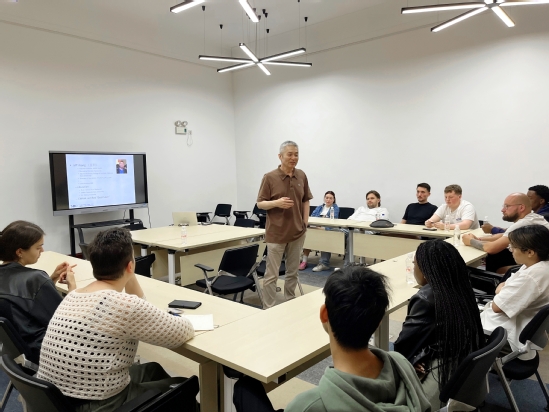
Jeffrey Wang in conversation with international students
A Shanghai Connection: Multicultural Exchange as the Hallmark of Our Educational Mission
Although I only moved to Shanghai in 2023, dozens of business trips have given me deep ties to this city. Shanghai is open and inclusive, bringing together diverse cultures; it both carries history and surges with the vitality of development. This diversity and vitality also permeate the cross-cultural atmosphere of SBC — in activities such as the International Summer School and international student orientation, I often talk with international students, encouraging them to experience Shanghai’s cultural heritage and industrial and technological development firsthand, and encouraging young people from different cultural backgrounds to engage in sincere dialogue. And like this city, I move forward between change and constancy — what changes is the trajectory from mathematics to business, from the corporate world to the podium; what remains unchanged is my passion for nurturing students.

