



Recently, SHENG Huayi, Class of 2023 in Electrical and Electronic Engineering, published the research achievement titled “Simulating an Integrated Photonic Image Classifier for Diffractive Neural Networks” in Micromachines (3.4, JCR-Q2), included in the Special Issue Devices in Silicon Photonics. SHENG Huayi was the first author; Dr Muhammad Shemyal Nisar was the corresponding author.
The slowdown of Moore’s law and the existence of the “von Neumann bottleneck” has led to electronic-based computing systems under von Neumann’s architecture being unable to meet the fast-growing demand for artificial intelligence computing. However, all-optical diffractive neural networks can outperform conventional siliconbased electronic neural networks due to the significantly higher speed of the propagation of optical signals compared to electrical signals, their parallelism in nature, and their low power consumption, which provides a possible solution to this challenge.
In this paper they presented a detailed design framework for the integrated diffractive deep neural network (ID2NN) and corresponding silicon-on-insulator integration implementation through Python-based simulations. The performance was successfully simulated, trained, and tested using the MNIST dataset of Python, demonstrating the convergence of optical and computational approaches.
This study sets the stage for the potential intensive application of photonic neural networks in the future. This could be achieved by harnessing the full potential of photonics, phase-change materials, and optimized photonic crystals to design a compact, reprogramable platform that operates at the speed of light.
In recent years, Sino-British College has placed strong emphasis on the development of students’ research capabilities, with a particular focus on fostering innovation, critical thinking, and active engagement in scholarly activities. Through the implementation of a personal tutoring scheme, every student is assigned an academic supervisor who provides tailored guidance throughout their undergraduate studies. Students are actively encouraged to join their supervisors’ research groups and participate in ongoing projects, thereby enhancing their analytical skills and scientific inquiry from an early stage. This structured approach has yielded increasingly notable outcomes in undergraduate research output and academic achievement.
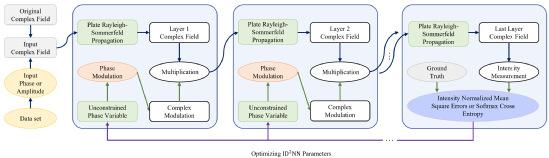
Design framework of the integrated diffractive deep neural network.
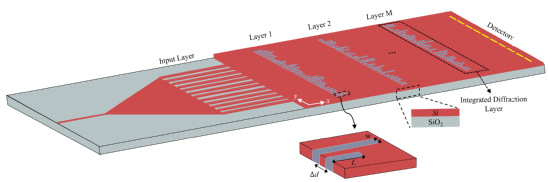
Schematic of the integrated diffractive deep neural network showing a single input connected to the taper that feeds into the input layer.
Link to the paper: https://doi.org/10.3390/mi15010050

