


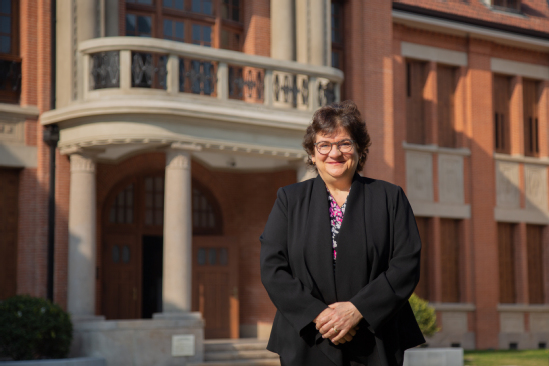
Professor Laura C. Bishop, Executive Dean of the Sino-British College, USST
A Personal Calling: How Her Own Journey Shapes Her Leadership
Professor Bishop has been connected to SBC for many years, witnessing and contributing to its growth. She first took on the leadership and management of SBC in 2018, immersing herself in the day-to-day work of the College. Now, in 2026 – a milestone year for both the University and the College – she has returned to the Fuxing Road campus to serve again as Executive Dean, drawing on her extensive experience in international education management and research to lead SBC into its next phase.
The first member of her family to go to university, Professor Bishop knows first-hand how higher education can broaden horizons and change lives. She was admitted to Yale as an undergraduate, then returned there for a PhD in anthropology, followed by post-doctoral research at New York University. Throughout, she has pursued her passion for human evolution with remarkable dedication. But the path was not always easy. As an undergraduate surrounded by talented and accomplished peers, she struggled to see how to fit within the university community, both academically and socially. That experience taught her something she has never forgotten: education is not just about sharing knowledge. It is about inspiring young people, giving them the support, confidence, and encouragement they need to find their own way.
Her first real taste of teaching came during her PhD, when she mentored an undergraduate researcher. She still remembers the student sitting across from her, his eyes full of uncertainty – just as hers had been. Instead of giving him answers, she helped him break down problems and work through his thinking step by step. Weeks later, he ran to her, excited to share his own epiphany on his learning journey. “That was the moment I understood what education really means,” she recalls. “It’s not about telling students the answer. It’s about helping them find their own path.” That experience ignited her passion for teaching – a passion that has grown alongside her research ever since.
Building Bridges Across Borders: A Global Perspective
She describes that first visit as a “life-changing experience.” She still remembers the afternoon clearly: walking along the tree-lined avenue on the Fuxing Road campus, sunlight filtering through the plane trees, a group of Chinese and international students and staff sitting on the library lawn, laughing and talking in a mix of Chinese and English. “I suddenly realised,” she says, “that this is what education looks like at its best – not divided by culture, but bringing different ideas and perspectives together.” In that moment, she knew she wanted to stay.
As an anthropologist, Professor Bishop has spent her career navigating different cultures. She has lived and worked with researchers and local communities at sites in East Africa. She has spent countless hours in Liverpool labs with colleagues from a dozen different countries, including China. These experiences have convinced her that education is one of the most powerful forces for building understanding across cultures. Sino-foreign collaborative education, she believes – bringing together high-quality resources and expertise from different countries – is a powerful way to help young people cross geographical and cultural boundaries and access a world-class education. She is deeply optimistic about the future of this work in China.
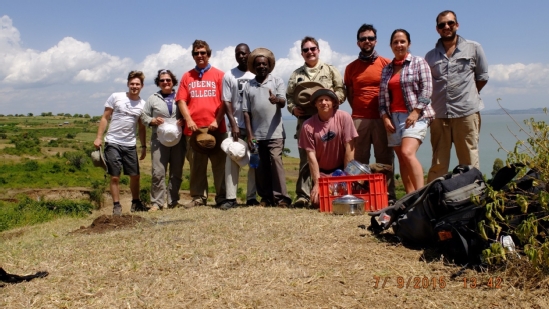
Professor Bishop (second from left) conducting fieldwork with her research team
Connecting Research and Teaching: Empowering Students Through Cross-Disciplinary Thinking
Professor Bishop has published over 70 academic papers. During her first term at SBC (2018–2021), she contributed as a key researcher to a study that was eventually published in Science in 2023. But she is quick to share the credit. “Research is never a solo endeavour,” she says. “In anthropology and archaeology, the best work comes from teams – from people with different disciplinary backgrounds and from different countries, working together. It brings a better variety of perspectives and skills to every project.”
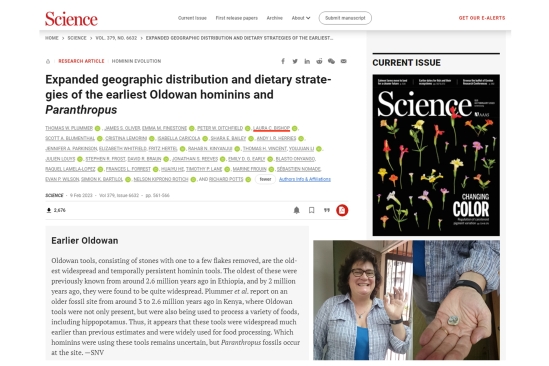
Professor Bishop’s research achievements from her time at SBC were published in the journal Science
Since joining SBC, she has been helping catalyse SBC’s next phase of development by building the research capacity through research-informed teaching. Her background in anthropology has given her a distinctive perspective that she brings to SBC’s engineering and business education. She often tells students and colleagues: “In archaeology, there is rarely one single ‘right answer.’ There are only conclusions that you test, debate, and refine – again and again. The same is true in life and in learning.”
In the summer of 2019, at the SBC T1 Scholarship Programme final, a first-year student gave a presentation in English on how innovative technologies affect society. Instead of citing dry statistics, she offered an unexpected angle: “People from different cultural backgrounds may understand and use new technologies in completely different ways.” Professor Bishop, who was on the judging panel, listened closely. After the awards ceremony, she walked over to the student, shook her hand, and said quietly: “Well done. Hold on to that way of thinking. An international education will help you see the different worlds that different answers can open up.” Years later, that student graduated with a master’s degree from Oxford. She turned down offers from several prestigious companies and returned to Shanghai to become a teacher at a school for children of expatriate families. Standing in front of her own classroom, facing students from all over the world, she often thinks back to that summer afternoon – and the person who encouraged her to see a bigger world. She wanted to become that person, too.
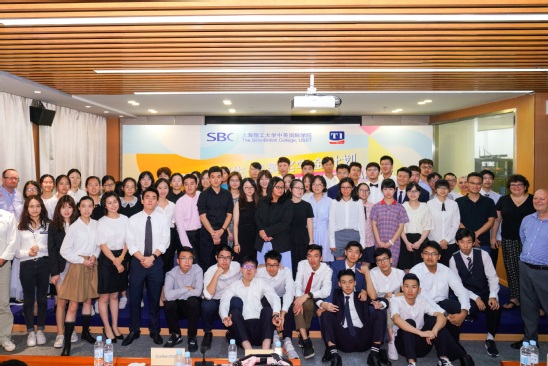
2019 SBC T1 Scholarship Programme final
Leading with Empathy: The Power of Listening
In 2018, Professor Bishop started what has become a signature initiative at the College: the “Executive Dean’s Afternoon Tea.” Tea, she notes, has historically connected China and England – albeit with different traditions and rituals, but a shared appreciation for sitting down together. It has become a simple but powerful way for her to listen to students.
One conversation stands out in her memory. A first-year student sat across from her, barely able to make eye contact. “My English isn’t very good,” the student whispered. “I’m afraid to speak in class. I feel like everyone else is better than me.” Professor Bishop poured her a cup of tea and said gently: “You know, when I first came to China, I couldn’t understand a word of Chinese. At the canteen, I kept pointing at dishes, and the server still had no idea what I wanted.” The student looked up, surprised. She smiled and continued: “But I kept learning a little every day. Now, at least I understand when you say ‘afternoon tea.’ You don’t have to be perfect from the start. Take it step by step. I’ve been there too.” That student later became an active participant in College life. In her second year, she even hosted events in English. After two years at SBC, she went on to the University of Sheffield, earned a PhD in engineering from the University of Manchester, and now works in the UK. “That,” Professor Bishop says, “is what the afternoon tea is really about – not solving students’ problems for them, but letting them know that someone is willing to listen, and that someone truly understands.”
Through these relaxed, honest conversations, students share their academic worries, personal struggles, and ideas for how the College could improve. Professor Bishop listens carefully. She passes constructive suggestions on to the College’s executive team. Over time, she has watched students grow more confident, more articulate, and more capable. And in that cup of tea, she has come to understand Chinese young people in a deeper way.
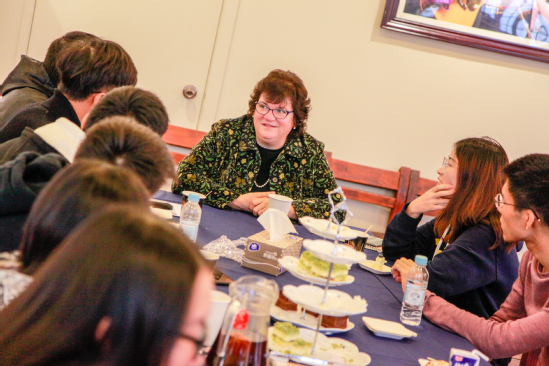
Professor Bishop in a warm conversation with students at the “Executive Dean’s Afternoon Tea”
Carrying Forward a Legacy: USST at 120, SBC at 20
Standing at this historic moment – USST’s 120th anniversary and SBC’s 20th – Professor Bishop is reflective. She notes that over two decades, building on USST’s strengths and the resources of multiple British partner universities, the College has grown into a thriving international platform serving over 1700 students. The “one-to-N” consortium model – SBC’s distinctive feature – has been key to that success.
Looking forward, she wants to deepen industry-education integration between China and the UK. “Sino-British cooperation in education is a two-way bridge,” she emphasises. “It helps UK universities understand China’s history, its innovations, development and education ecosystem – and to provide the same access for USST to the UK and beyond.”
On this double anniversary, she sends her best wishes to USST – to carry forward its legacy of excellence for generations to come – and to SBC, hoping it will go from strength to strength and serve as an inspirational example of international cooperation in higher education. And every afternoon, she will still be there, in her office overlooking the plane trees, ready to listen to the next student who wants to talk.

