



King Charles and Queen Camilla received LJMU’s Vice Chancellor as the university formally accepted the 2026 Queen Elizabeth Prize – the nation’s highest award for education.
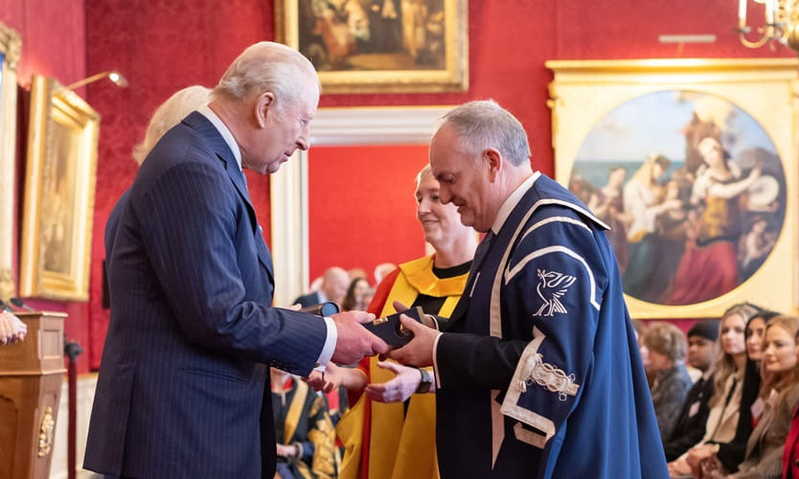
Professor Mark Power and Professor Caroline Wilkinson, Director of the university’s winning research centre - Face Lab - received the Prize medal and scroll personally from the King and Queen at St James’s Palace, London early this afternoon.
The Queen Elizabeth Prize was awarded in recognition of LJMU’s pioneering work with Face Lab, a research centre which reconstructs the faces of victims of crime, migrant refugees and well-known figures from history, including royalty!
Previously called The Queen’s Prize for Industry, the honour was previously made to LJMU in 2006 for work to engage British schoolchildren in astronomy and astrophysics.
Professor Power and Professor Wilkinson were accompanied at the ceremony by Chancellor Nisha Katona.
Faces of the dead
Established in 2015, Face Lab combines art, history, anatomy and digital technology to reconstruct the faces of the dead, delivering projects for the police and law enforcement agencies, heritage projects, museums and cultural institutions.
Professor Wilkinson said: “We are thrilled to have been awarded one of the Queen Elizabeth Prizes for Education. I work with really amazing people in Face Lab and this is a recognition of all their hard work over the last 10 years and keeping ahead of the advances in technology to work in our field.”
In the digital heritage field, Face Lab has pioneered the creation of authentic digital avatars of international historical figures such as Richard III, Pharaoh Rameses III and Robert The Bruce and recreated the faces of stolen indigenous remains of native South Africans, handing them back their humanity and dignity.
In the forensic field, Face Lab contributes to national and international investigation leading to the identification of unidentified bodies and indirectly to the criminal conviction of those responsible for murder.
In the university, Face Lab researchers established the distinctive Art in Science Master’s programme, focusing on interdisciplinary research between art and STEM subjects and training the next generation of global art-science practitioners.
About the Queen Elizabeth Prizes for Education
Managed by the Royal Anniversary Trust, the prizes were first awarded in 1994 and are part of the UK national honours system. The prizes are awarded to a small number of institutions every two years by the Monarch on the advice of the Prime Minister following a rigorous, independent process.
This is the second time LJMU has won the prestigious award having previously been awarded the honour (then known as the Queen’s Anniversary Prizes) in 2006 for the outstanding work and public engagement activity of the Astrophysics Research Institute.
Sir Damon Buffini, Chair of the Royal Anniversary Trust said: “The Queen Elizabeth Prizes for Higher and Further Education celebrate the power of education to change the world for the better.
“This much-loved national honour recognises, at the highest level of state, outstanding work in UK universities and colleges, and the remarkable benefit they bring to our economy, society and the wider world. This year we are delighted to honour 19 institutions whose work offers an inspiring snapshot of the excellent and innovative work going on in universities and colleges across the UK. Congratulations all!”
More about Face Lab
Face Lab is an interdisciplinary education, research and knowledge exchange unit at the interface of art and science with a focus on individual and population facial identity, depiction and identification.
In the digital heritage field, Face Lab has pioneered the creation of authentic digital avatars of international historical figures and several projects have been innovative in the use of novel technologies and analyses alongside historical research.
In the forensic field, Face Lab contributes to national and international investigation leading to the identification of unidentified bodies and indirectly to the criminal conviction of those responsible for murder.

